
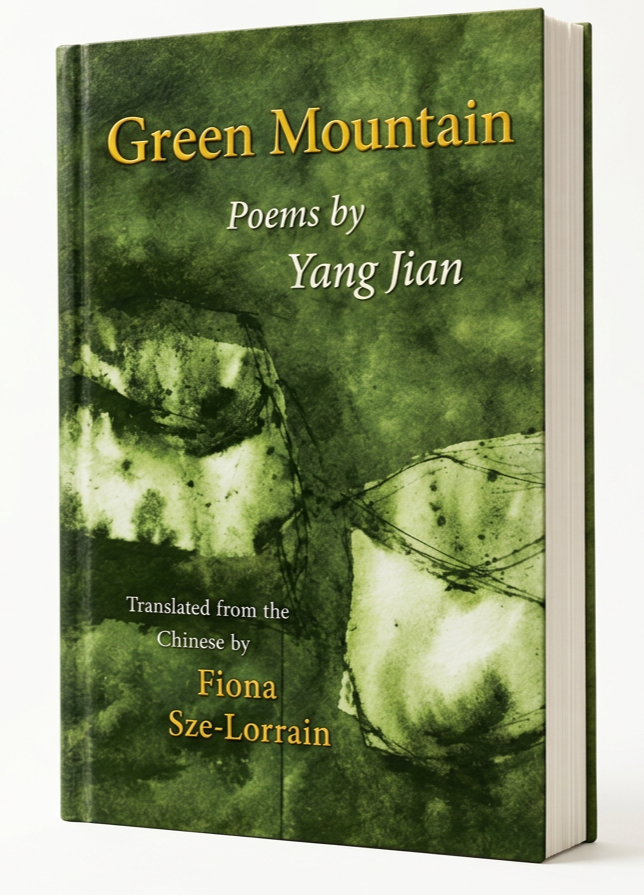
Green Mountain
Poems by Yang Jian
2020
/ Bilingual edition
ISBN: 978-1-937385-36-1
Format: paperback, 154 pages
Translators
Fiona Sze-Lorrain’s poetry collection is The Ruined Elegance (Princeton, 2016). A zheng harpist and translator, she was an Abigail R. Cohen Fellow at the Columbia Institute for Ideas and Imagination.
Christopher Merrill has authored twelve books of poetry and nonfiction, including Self-Portrait with Dogwood (Trinity, 2017).
One of the most important contemporary Chinese poets, Yang Jian was born in Anhui province in 1967. He paints in ink and leads a Buddhist life in Ma’anshan.
A representative selection of lyrical poems by contemporary Chinese poet and painter Yang Jian, also a Buddhist, in Fiona Sze-Lorrain’s elegant translation. Exploring history, faith, memory, nature, and the various transient complexities of human existence, these poems seek a pure form of simplicity in thought and style, reminiscent of meditative beauty and Asian ink-wash painting aesthetics.
Yang Jian is the rarest of contemporary Chinese poets who takes on the excesses of modernization and materialism. In his signature style of economy and imagery, which Fiona Sze-Lorrain has rendered in English with precision, Yang creates a poetic landscape of hermit living which is as enthralling as it is illusory.
Dian Li, Professor of modern Chinese literature
[This] translation captures the spare essence of Yang Jian’s poetry in all its honesty and in its deep expression of his…Buddhist faith [and]offers the reader a rich and delicate portrait of the poet’s world in all its complexity. Sze-Lorrain’s profound knowledge of Yang Jian’s language, as well as her sensitivity to his imagery, enables her to provide a vivid portrait of both his spiritual and mundane life.
Morris Rossabi, City University of New York / Columbia University
[These] translations meticulously present Yang Jian’s sickly, serene landscapes, where feeling resists sentimentality and witness resists idolatry. [Sze-Lorrain] leads us through rain, dust, and decay with bracing directness, inviting us to hear the “archaic beauty” of the poet’s voice and glimpse a vision “as vivid as devastation.”
Jennifer Zoble, New York University